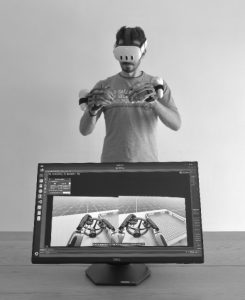
As robotics moves toward more capable humanoids and general-purpose physical AI systems, one of the biggest bottlenecks is the quality of human demonstration data. Robot policies do not only need more data. They need better demonstrations: precise, repeatable, and rich enough to capture the details of human dexterity.
At Haptikos, we are developing exoskeleton-based technology that captures high-fidelity human hand motion and enables more natural teleoperation and data collection workflows for robotics. Haptikos exoskeletons are now supported as an input device for the open NVIDIA Isaac Teleop and NVIDIA Isaac Lab frameworks, enabling exoskeleton-based hand tracking for robot teleoperation and imitation-learning data collection. This allows robotics teams to use Haptikos exoskeletons to capture human hand motion and generate demonstrations for learning-from-demonstration pipelines.
From teleoperation to imitation learning
To evaluate the integration, we followed NVIDIA Isaac Lab’s teleoperation and imitation-learning workflow with Isaac Lab Mimic. This workflow connects human demonstrations, dataset generation, policy training, and rollout evaluation. It is designed to help robotics teams move from manual teleoperation to scalable learning-from-demonstration pipelines.
Using Haptikos, we tested dexterous teleoperation and data collection in Isaac Lab scenarios, including a pick-and-place workflow and a second visuomotor policy scenario.
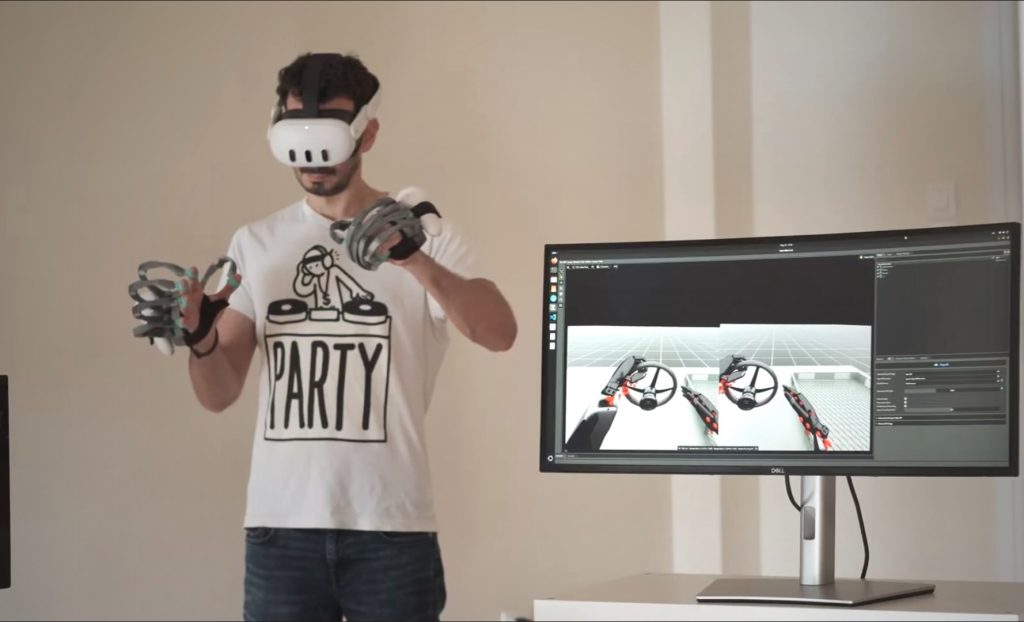
Video demo: Haptikos exoskeletons used as an input device to teleoperate a humanoid robot in the Pick and Place GR1T2 Task inside NVIDIA Isaac Sim. Click the image to watch the full demo.
Early internal evaluation
To evaluate the Haptikos integration, we tested two Isaac Lab Mimic workflows: the Pick and Place GR1T2 Task and the Visuomotor Nut Pour GR1T2 Task.
For the Pick and Place GR1T2 Task, NVIDIA’s Isaac Lab documentation reports that Behavior Cloning policy success is typically 75–86% when evaluated over 50 rollouts, after training on 1,000 generated demonstrations for 2,000 epochs.
In our internal evaluation of the Pick and Place GR1T2 Task using Haptikos exoskeleton input, we first observed a significant improvement in demonstration collection efficiency. Completing 30 recordings with Haptikos took around 10 minutes, with only 2 resets. Using headset-based optical hand tracking in the same setup, the same process took around 21 minutes and required 22 resets.
After training on the generated demonstrations, the policy achieved:
- 50 successful rollouts out of 50
- 499 successful rollouts out of 500
- 989 successful rollouts out of 1,000
We also tested the Visuomotor Nut Pour GR1T2 Task. NVIDIA’s Isaac Lab documentation reports that Behavior Cloning policy success for this task is typically 50–60% when evaluated over 50 rollouts, after training on 1,000 generated demonstrations for 600 epochs.
In our internal evaluation of the Visuomotor Nut Pour GR1T2 Task, our current setup reached 74% success over 50 rollouts.
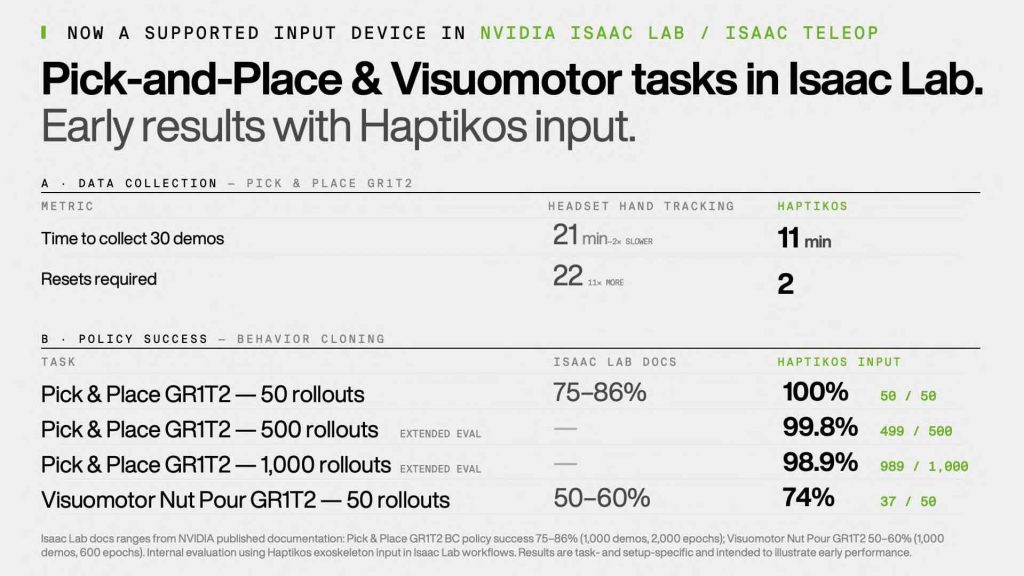
These are early internal results from specific simulation setups, and policy performance can vary depending on demonstration quality, annotation quality, training configuration, and checkpoint selection. Still, the results point to a broader opportunity: higher-quality human hand data can improve how robots are teleoperated, how demonstrations are collected, and how policies are trained.
Why exoskeleton-based input matters
Dexterous manipulation depends on small details: finger motion, grasp timing, pose consistency, and smooth human intent. For learning-based robotics systems, these details become part of the data foundation. If the demonstration signal is noisy, unstable, or difficult to reproduce, the downstream policy inherits those limitations. Haptikos is designed to provide precise and reliable hand motion data through an exoskeleton-based interface. This creates a more direct path from human skill to robot behavior, supporting workflows where operators can teach robots through natural hand movement rather than abstract controls.
Toward scalable physical AI data collection
The integration with NVIDIA Isaac Lab and Isaac Teleop is an important step toward our broader vision: enabling humans to transfer dexterity, intent, and skill into robotic systems. By combining Haptikos exoskeletons with Isaac Teleop and Isaac Lab frameworks, robotics teams can explore a more scalable path for collecting demonstrations, generating datasets, and training policies in simulation before moving toward real-world deployment. We are continuing to refine the integration, prepare developer documentation, and expand testing across additional robots and scenarios.
Learn more
Haptikos documentation for Isaac Lab and Isaac Teleop has been prepared to provide step-by-step guidance for using Haptikos exoskeletons as a supported input device inside NVIDIA Isaac frameworks.
Read the Haptikos integration documentation → nvidia.github.io/…op/main/device/haptikos
For robotics teams working on dexterous teleoperation, humanoid robotics, or physical AI data collection, we would be happy to connect and explore how Haptikos can support your workflow.